SYSTEMA APS extends its predictive scheduling platform with Decision Cockpit capabilities that make scenario evaluation more systematic, more reproducible, and easier to operationalize. Building on the benchmarking refinements introduced in v2025.3, this release strengthens the full workflow around experiments, KPI scorecards, and controlled execution—so industrial engineering teams can prove improvements offline before rolling them into line control.
Decision Cockpit
Turn what-if analysis into repeatable, KPI-backed engineering decisions
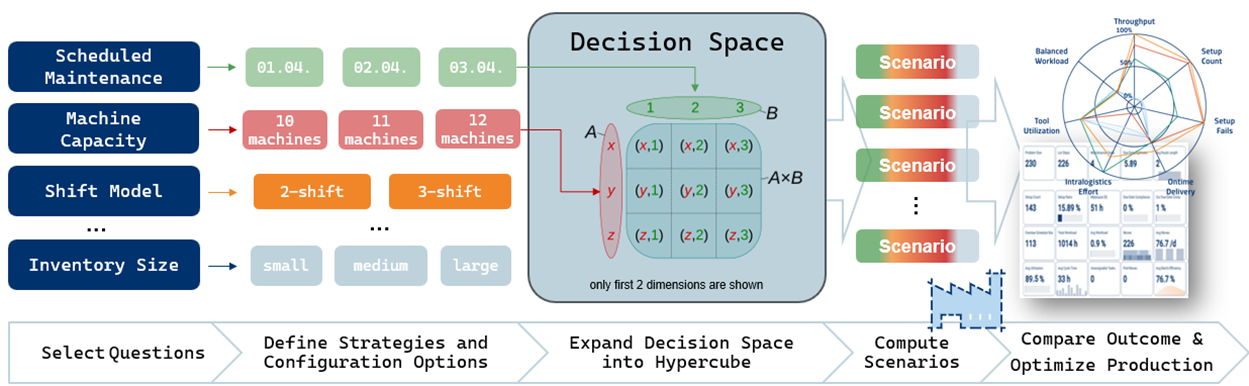
SYSTEMA APS v2026.1 rethinks its risk-free sandbox environment for scenario evaluation, making it fit naturally into the day-to-day flow of industrial engineering: define alternatives, run them in a controlled way, compare outcomes consistently, capture a defensible decision, and then replay the same study when WIP, fab state, or assumptions change.
Coherent & Structured What-if studies
Decision Cockpit upgrades the evaluation loop from “run and inspect” to a structured workflow:
- Organize results as runs grouped into experiments, enabling side-by-side comparison of alternatives
- Provide navigation and context from a run to its experiment, so results remain interpretable
- Maintain history and replay, allowing teams to revisit and re-execute studies when conditions change
Advanced control over production dynamics
Configuration becomes a first-class engineering object that supports repeatability and consistent execution:
- Replicate control to balance evaluation runtime against confidence (quick checks vs robust validation)
- Report generation hooks to produce review artifacts from runs
- Improved structuring of configuration elements to support standardized execution patterns
KPI matrix & weighted scorecard
Decision Cockpit improves KPI handling to support selection—not just observation:
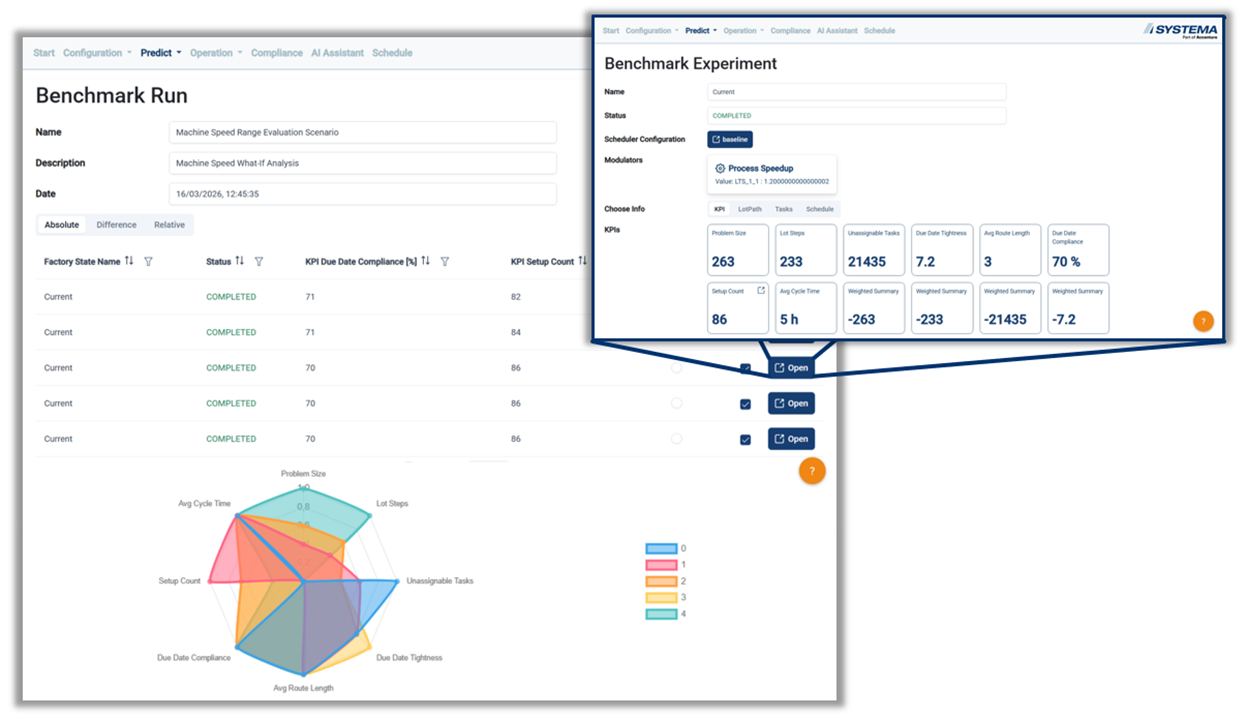
- KPI results shaped for clear comparison with a consistent per-run structure
- Weighted KPI scorecard to aggregate multiple objectives into a single ranking where desired
- Improved KPI consistency (e.g., rounding refinements) to reduce noise in comparisons
Operational robustness & automation
More predictable updates when factory state evolves:
- Monitoring to detect relevant state updates and trigger recompute for active configurations
- Hardened edge cases around active schedule handling and refresh behavior
Usability improvements
Practical UI refinements reduce friction during evaluation and review:
- Improved benchmark run presentation and basic information forms
- Table and navigation refinements to speed up comparison
- Styling and interaction polish for day-to-day use under real data volumes
Dynamic Attribute Definitions
Turn fab context into a control lever. With Dynamic Attributes in SYSTEMA APS, engineers can define new lot, equipment, or schedule attributes on the fly and reuse them immediately in filters, KPI views, and priority rules. Powerful expression completion and context-aware suggestions make it fast to build correct formulas—even in complex models. The result: quicker tuning cycles, richer visibility, and better scheduling decisions without waiting for code changes. Recalculate the scheduler configuration to apply the new context to the schedule.
Advanced material-flow restrictions
We added/extended four dynamic (stateful) restrictions that update after each dispatch—so constraints like spacing, density, grouping, and equipment capacity behave realistically as the sequence evolves:
- Block Building: group consecutive lots by an attribute (optional value) with configurable min/max block size.
- Minimum Distance: enforce minimum spacing between lots matching an attribute/value to prevent clustering.
- Density Filter: cap the maximum count of matching lots within a sliding window (n lots per interval k).
- Capacity Restriction: track capacity per equipment over a period, enforcing max and optional min bounds (optional start capacity).
More flexible BOMs for real-world assemblies
We improved BOM support to better reflect real manufacturing use cases
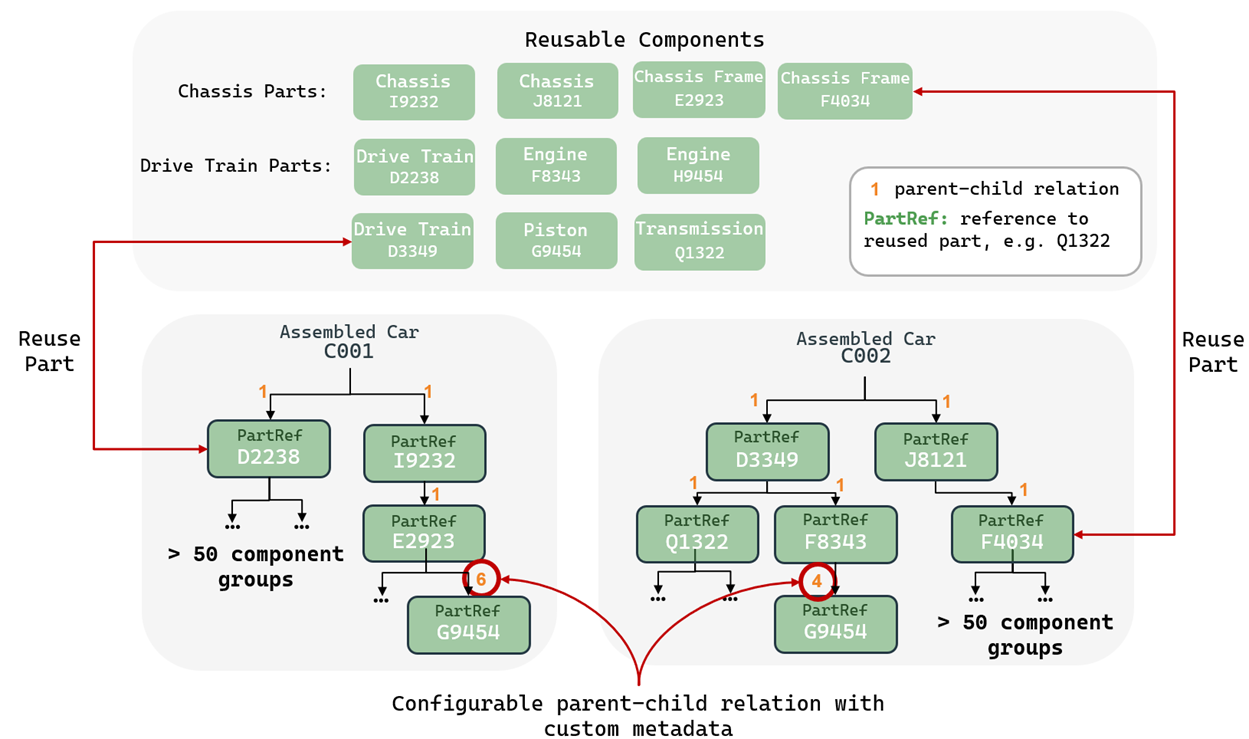
- More flexible part usage: the same component can appear in multiple products with different quantities and different “where it gets added” steps.
- Better support for complex structures: assemblies can be modeled with richer parent–child relationships (not just a simple tree), making variants and reuse easier.
- Validated, safer models: the system checks that “insert at step X” actually exists in the routing, preventing inconsistent BOM definitions.
- Scales to larger BOMs: improvements were verified with large BOM examples to ensure good performance as product structures grow.
Other Improvements
Beyond the headline features, this release includes additional enhancements across UI, documentation, and delivery tooling
Integration Improvements
- Improved performance of database integration
- Consolidated ingest paths of factory state changes
- Restructured REST API for more consistency & security
- New configurable security model
UI Enhancements
- Configurable schedule colors
- New color legend in schedule view
- Help button updated to open in a new tab.
- Improved navigation and insights into master data
Model Improvements
- Improved scheduling robustness & performance
- Significantly improved KPI performance
- Validators are now configurable via scheduling configurations
- The APS developer kit has been substantially enhanced and expanded, empowering customers to build models programmatically. It now features advanced analytical tools, a comprehensive model catalog, integrated AI support, and upgraded documentation for a smoother development experience
- Updated user guide: expanded Digital Twin framework details, revised core simulator description, refined key concepts
Documentation Updates
- Updated developer documentation to include new registries (KPI, Validation)
- Updated database schema description
- Added “Order Dedication Priority” scheduling rule documentation.
- Improved model documentation in multiple commits.
Conclusion
SYSTEMA APS Decision Cockpit strengthens APS as a predictive digital twin for scheduling and advanced what-if analytics by turning scenario evaluation into a repeatable, KPI-backed selection workflow.
 With structured experiments, replicate control, and scorecard-driven comparison - supported by more predictable recompute behavior - teams can validate changes offline, align stakeholders with evidence, and deploy improvements with confidence.